Thursday, October 24, 2013

Ultrasound device combined with clot-buster safe for stroke, say UTHealth researchers

Ultrasound device combined with clot-buster safe for stroke, say UTHealth researchers


[ Back to EurekAlert! ]

PUBLIC RELEASE DATE:

24-Oct-2013


[


| E-mail

]


Share Share

Contact: Deborah Lake
deborah.m.lake@uth.tmc.edu
713-500-3304
University of Texas Health Science Center at Houston


HOUSTON (Oct. 24, 2013) A study led by researchers at The University of Texas Health Science Center at Houston (UTHealth) showed that a hands-free ultrasound device combined with a clot-busting drug was safe for ischemic stroke patients.


The results of the phase II pilot study were reported today in the American Heart Association journal Stroke. Lead author is Andrew D. Barreto, M.D., assistant professor of neurology in the Stroke Program at the UTHealth Medical School. Principal investigator is James C. Grotta, M.D., professor and chair of the Department of Neurology at the UTHealth Medical School, the Roy M. & Phyllis Gough Huffington Distinguished Chair and co-director of the Mischer Neuroscience Institute at Memorial Hermann-Texas Medical Center.


The device, which uses UTHealth technology licensed to Cerevast Therapeutics, Inc., is placed on the stroke patient's head and delivers ultrasound to enhance the effectiveness of the clot-busting drug tissue plasminogen activator (tPA). Unlike the traditional hand-held ultrasound probe that's aimed at a blood clot, the hands-free device used 18 separate probes and showers the deep areas of the brain where large blood clots cause severe strokes.


"Our goal is to open up more arteries in the brain and help stroke patients recover," said Barreto, an attending physician at Mischer Neuroscience Institute. "This technology would have a significant impact on patients, families and society if we could improve outcomes by another 10 percent or more by adding ultrasound to patients who've already received tPA."


In the first study of its kind, 20 moderately severe ischemic stroke patients (12 men and eight women, average age 63 years) received intravenous tPA up to 4.5 hours after symptoms occurred and two hours exposure to 2-MHz pulsed wave transcranial ultrasound.


Researchers reported that 13 (or 65 percent) patients either returned home or to rehabilitation 90 days after the combination treatment. After three months, five of the 20 patients had no disability from the stroke and one had slight disability.


Cerevast Therapeutics has recently launched an 830-patient international, randomized efficacy study of the ultrasound approach combined with the clot buster in ischemic stroke. Barreto is the North American principal investigator for that Phase III study called Combined Lysis of Thrombus with Ultrasound and Systemic Tissue Plasminogen Activator (tPA) for Emergent Revascularization in Acute Ischemic Stroke (CLOTBUST-ER). Locally, patients will be recruited from Memorial Hermann-Texas Medical Center, Memorial Hermann Southwest Hospital and Baptist Beaumont Hospital.

###


The study was conducted at UTHealth and the University of Alabama-Birmingham with funding from the National Institutes of Health (NIH) including the National Institute of Neurological Disorders and Stroke (P50NS044227, 1K23NS02229-01, 1P50NS044277), an NIH training grant (T32NS07412) and the National Center for Research Resources (UL1RR024148).


UTHealth co-authors are Nicole Gonzales, M.D.; Sean I. Savitz, M.D.; Andrew Bursaw, M.D.; Preeti Sahota, M.D.; Renganayaki Pandurengan, Ph.D.; Mohammad Rahbar, Ph.D.; Loren Shen, B.S.N.; Manouchehr Ardjomand- Hessabi, M.D.; Hari Indupuru, M.B.B.S.; and Hui Peng, Ph.D. Other co-authors are Andrei Alexandrov, M.D.; April Sisson, R.N.; and Kristian Barlinn, M.D.


[ Back to EurekAlert! ]

[


| E-mail


Share Share

]


AAAS and EurekAlert! are not responsible for the accuracy of news releases posted to EurekAlert! by contributing institutions or for the use of any information through the EurekAlert! system.


Ultrasound device combined with clot-buster safe for stroke, say UTHealth researchers


[ Back to EurekAlert! ]

PUBLIC RELEASE DATE:

24-Oct-2013


[


| E-mail

]


Share Share

Contact: Deborah Lake
deborah.m.lake@uth.tmc.edu
713-500-3304
University of Texas Health Science Center at Houston


HOUSTON (Oct. 24, 2013) A study led by researchers at The University of Texas Health Science Center at Houston (UTHealth) showed that a hands-free ultrasound device combined with a clot-busting drug was safe for ischemic stroke patients.


The results of the phase II pilot study were reported today in the American Heart Association journal Stroke. Lead author is Andrew D. Barreto, M.D., assistant professor of neurology in the Stroke Program at the UTHealth Medical School. Principal investigator is James C. Grotta, M.D., professor and chair of the Department of Neurology at the UTHealth Medical School, the Roy M. & Phyllis Gough Huffington Distinguished Chair and co-director of the Mischer Neuroscience Institute at Memorial Hermann-Texas Medical Center.


The device, which uses UTHealth technology licensed to Cerevast Therapeutics, Inc., is placed on the stroke patient's head and delivers ultrasound to enhance the effectiveness of the clot-busting drug tissue plasminogen activator (tPA). Unlike the traditional hand-held ultrasound probe that's aimed at a blood clot, the hands-free device used 18 separate probes and showers the deep areas of the brain where large blood clots cause severe strokes.


"Our goal is to open up more arteries in the brain and help stroke patients recover," said Barreto, an attending physician at Mischer Neuroscience Institute. "This technology would have a significant impact on patients, families and society if we could improve outcomes by another 10 percent or more by adding ultrasound to patients who've already received tPA."


In the first study of its kind, 20 moderately severe ischemic stroke patients (12 men and eight women, average age 63 years) received intravenous tPA up to 4.5 hours after symptoms occurred and two hours exposure to 2-MHz pulsed wave transcranial ultrasound.


Researchers reported that 13 (or 65 percent) patients either returned home or to rehabilitation 90 days after the combination treatment. After three months, five of the 20 patients had no disability from the stroke and one had slight disability.


Cerevast Therapeutics has recently launched an 830-patient international, randomized efficacy study of the ultrasound approach combined with the clot buster in ischemic stroke. Barreto is the North American principal investigator for that Phase III study called Combined Lysis of Thrombus with Ultrasound and Systemic Tissue Plasminogen Activator (tPA) for Emergent Revascularization in Acute Ischemic Stroke (CLOTBUST-ER). Locally, patients will be recruited from Memorial Hermann-Texas Medical Center, Memorial Hermann Southwest Hospital and Baptist Beaumont Hospital.

###


The study was conducted at UTHealth and the University of Alabama-Birmingham with funding from the National Institutes of Health (NIH) including the National Institute of Neurological Disorders and Stroke (P50NS044227, 1K23NS02229-01, 1P50NS044277), an NIH training grant (T32NS07412) and the National Center for Research Resources (UL1RR024148).


UTHealth co-authors are Nicole Gonzales, M.D.; Sean I. Savitz, M.D.; Andrew Bursaw, M.D.; Preeti Sahota, M.D.; Renganayaki Pandurengan, Ph.D.; Mohammad Rahbar, Ph.D.; Loren Shen, B.S.N.; Manouchehr Ardjomand- Hessabi, M.D.; Hari Indupuru, M.B.B.S.; and Hui Peng, Ph.D. Other co-authors are Andrei Alexandrov, M.D.; April Sisson, R.N.; and Kristian Barlinn, M.D.


[ Back to EurekAlert! ]

[


| E-mail


Share Share

]


AAAS and EurekAlert! are not responsible for the accuracy of news releases posted to EurekAlert! by contributing institutions or for the use of any information through the EurekAlert! system.


Source: http://www.eurekalert.org/pub_releases/2013-10/uoth-udc102413.php
Related Topics: When Was The First Parachute Jump?   Why Did The Government Shut Down   elton john   Costa Concordia   Hannah Davis  

Wall Street gains on Fed hopes, rise in homebuilder stocks


By Caroline Valetkevitch

NEW YORK (Reuters) - U.S. stocks resumed their upward move on Thursday as economic data underscored views U.S. monetary stimulus will be in place for the foreseeable future and as earnings offered some upbeat news.

Shares of PulteGroup Inc jumped after the homebuilder reported results and said a slowdown in new home orders would be "short-lived." Its shares jumped 7 percent to $17.85 and were the biggest percentage gainer on the S&P 500, while shares of D.R. Horton Inc rose 2.1 percent to $19.87 and Beazer Homes Inc added 1.5 percent to $19.41.

Economic data showed initial claims for state unemployment benefits fell less than expected in the latest week, though analysts noted a backlog of applications in California. On Tuesday, data showed that employers added fewer jobs than expected in September.

The day's data also included a preliminary look at Markit's October Manufacturing Purchasing Managers Index, which grew at its slowest pace in a year while factory output contracted for the first time since late 2009.

Expectations the Fed will continue its stimulus have helped stocks all year, with the index up 22.8 percent so far for 2013.

The S&P 500 declined on Wednesday, ending its four-session streak of record high finishes. Last week's legislation to avoid a debt default and end a partial government shutdown gave way to a relief rally and speculation that the Federal Reserve will delay scaling back its stimulus for several months.

"You've got this underlying liquidity surge that's propping prices up, and earnings season hasn't been poor," said Bucky Hellwig, senior vice president at BB&T Wealth Management in Birmingham, Alabama.

The Dow Jones industrial average <.dji> was up 95.88 points, or 0.62 percent, at 15,509.21. The Standard & Poor's 500 Index <.spx> was up 5.69 points, or 0.33 percent, at 1,752.07. The Nasdaq Composite Index <.ixic> was up 21.89 points, or 0.56 percent, at 3,928.96.

Also after the bell, Twitter said it intends to sell 70 million shares priced between $17 and $20 in an initial public offering that will value the company at as much as $10.9 billion.

Ford shares rose 1.4 percent to $17.76 after the automaker boosted its full-year global earnings and margin outlook, helped by an improved forecast in Europe and better-than-expected third quarter results.

Also on the rise were Apple shares , up 1.3 percent at $531.91, after investor Carl Icahn, in a public letter to Apple Chief Executive Tim Cook, called on Apple to commence a $150 billion share buyback immediately.

Third-quarter earnings overall has had its disappointments, including some weak outlooks and just 53 percent of companies so far beating analysts' revenue expectations, below the long-term average, according to Thomson Reuters data.

About 68 percent of companies are beating analysts' earnings expectations, above the 63 percent long-term average.

Among the day's decliners were Dow Chemical Co , Xerox Corp , which all fell following results and outlooks.

AT&T, a Dow component, fell 1.8 percent to $34.63 while Dow Chemical lost 1 percent to $40.62. and Xerox slumped 10.4 percent to $9.61 after a weak outlook.

Shares of Symantec Corp dropped 12.7 percent to $21.49 after it reported lower-than-expected second-quarter revenue and forecast current-quarter results below expectations.

After the bell, shares of Amazon.com rose 4.2 percent to $346 percent following the release of its results.

(Editing by Nick Zieminski and Kenneth Barry)

Source: http://news.yahoo.com/stock-futures-climb-earnings-data-tap-112501267--sector.html
Category: homeland   Ken Norton   rosh hashanah   Derek Medina   mumford and sons  

Burned, flooded Breezy Point tries to rebuild


A bench sits in front of the construction of homes a year after Hurricane Sandy devastated by fire in the Breezy …

NEW YORK — Superstorm Sandy caused one of the worst residential fires in New York City history, a blaze that burned unchecked for hours because floodwaters spurred by Sandy's 13-foot storm surge blocked firefighters from responding. Strengthened by wind gusts upward of 80 mph, the fire ultimately consumed nearly 130 homes in the heart of this tiny oceanfront neighborhood in Queens.

It was a horror story that resulted in some of the most memorable images of Sandy’s wrath, including an iconic photo of a singed Virgin Mary statue that stood amid the ashes of homes that once were standing.

What the fire didn’t destroy, the water tried to — and in many cases, did. Of Breezy Point’s 2,800 homes, roughly 200 were destroyed by the flood and more than 1,500 were severely damaged.

That includes Peggy Smith’s home along Atlantic Walk, where the entire first floor was washed away by Sandy. But she knows it could have been worse.

“I am one of the lucky ones,” said Smith, whose family roots in Breezy Point date back nearly 100 years to before there was even a bridge connecting the tiny peninsula to the rest of New York City.

Her home sits just one house away from what locals have come to call the “fire zone” — which one year after the storm remains an open gash where none of the residents has returned and only a handful of homes have started to be rebuilt.

Click image for more Yahoo News Sandy Anniversary coverage.

But for Smith and other community residents, Sandy's biggest effect is not just the missing houses — but the missing people whose fate seems uncertain.

Most of Breezy Point’s homes are densely packed together, linked to the road only by a sidewalk that also connects to the oceanfront. Within those clusters are houses damaged in the storm and that have remained largely untouched ever since. Some still have the “restricted” stickers that were slapped on their front doors by city inspectors in the weeks after the storm. Some are for sale, some are still in limbo as residents wait for insurance money for repairs, and some are just empty — and have been for the past year. No one really knows who is coming back and who is not.

“The mailman may be the only person who knows what happened to people,” Smith said.

A year after Sandy, local officials estimate that about half of Breezy Point residents are back. But among those who have returned, there's a sense of uncertainty around a neighborhood once so close-knit that few residents even bothered to lock their front doors because they felt so safe.

There is a fear that after Sandy, Breezy Point won’t ever be the same — and a fear of what another storm could mean for a community that has proven so fragile to the elements.

“Everybody is worried,” said Steve Greenberg, a longtime resident who once served as chairman of the Breezy Point Coop, which oversees the neighborhood. “I’ve had people say to me, ‘This is a once-in-a-700-year storm.’ Well, that doesn’t mean it can’t happen two years in a row.”

But, Greenberg added, “that doesn’t change the fact that we still want to be here.”

Greenberg’s home on Oceanside Avenue barely escaped last year’s fire. The blaze burned right toward his doorstep but was somehow contained at the house directly next door — something he describes as a “total miracle.”

His neighbors weren’t so lucky. Many didn’t have insurance, in part because they’d seen their relatives haggle with insurance companies over paying claims related to previous storms. And those who did have been slowed in their attempts to rebuild by insurance disputes and state and local bureaucracy.

Several residents whose lots were cleared by federal officials after the storm filed permits with the city months ago to rebuild, but they were rebuffed by building inspectors asking why they hadn't filed a proper demolition permit for their existing homes.

“Their homes burned down, and the debris was dragged away by the Army Corps of Engineers,” said Greenberg, who launched a disaster relief fund to help Breezy Point residents rebuild. “You would think somebody would know that, but those are the kind of snafus people have been dealing with.”

The neighborhood hasn’t been the same for those who have returned. Many of the local institutions were destroyed, including the Sugar Bowl, a popular beachfront bar that had been around for nearly 40 years. Kennedy’s, one of the few local restaurants, remains closed.

Residents talk about the neighbors they don’t see anymore — the people they might not have known but whose faces they recognized.

“People are back, but they are not back,” said Larry Deemer, another longtime resident. “You would normally hear life all around you. ... But some days, you don’t hear a sound. It’s been very odd."

Deemer suffered minor damage compared with many of his neighbors. His basement was flooded by more than six feet of water, which, among other things, destroyed his art studio. He was among the first to return to Breezy Point, moving back just weeks after the storm, as he rebuilt his basement living space.

He estimates that about half of those who live on his block are back. One house is for sale, after the family decided not to return. Another is empty while its owner waits to learn if he’ll have to raise his house to meet new flood zone height requirements enforced by the Federal Emergency Management Agency and the city. Other neighbors he hasn’t seen at all.

“It’s like the year has gone by, and I’m back to doing some of the things I was doing. ... But it’s still not quite the way it was,” Deemer said.

Over the summer, city and state officials worked to cut some of the red tape that had slowed rebuilding in Breezy Point. A permitting process that once threatened to be as long as 18 months was cut down to 110 days and, more recently, just 30 days. And within the past two weeks, on the eve of the Sandy anniversary, construction has launched on about a half-dozen homes.

At least two homes are in the advanced stages, including one owned by former Rep. Bob Turner next door to the home where the fire first started. While the area had been under mandatory evacuation during the storm, Turner and his wife tried to stay — but they quickly fled into floodwaters that were nearly up to their necks when they spotted flames next door. Within minutes, their home was on fire, too.

“We were prepared for the flood, but we weren’t prepared for the fire,” Turner said. “It just happened so quickly. You just felt helpless. There was little you could do but just concentrate on getting out of there.”

Turner, who left Congress in January and has been living in Brooklyn for the past year, hopes to be in his new home by Christmas.

Click on image for RELATED SLIDESHOW: A ghost town on Staten Island (Photo by Gordon Donovan/Yahoo News)

“Where we’ve been for the last year, it’s nice, but it’s not Breezy. It’s not home,” Turner said.

A half-block away from Turner’s new home, Smith has been back in her house since the early summer. She was among those in Breezy Point who didn’t have insurance, and she emptied her retirement account to rebuild her home. She declines to say how much she spent but said she is applying for grants to help cover some of the costs. 

“I took a chance, and I lost,” Smith said. “I’ll never be able to retire. It’s a good thing I like my job, right?”

She doesn’t want to think about what might happen if another storm like Sandy came along. If it did, she admits, “It would be over for me here.”

But Smith says she never considered not rebuilding. She likes the quirkiness of the community — how a siren rings at noon to alert residents that it’s time for lunch and how most people get around by bike, as opposed to car. She wants future generations of her family to enjoy Breezy Point just as she has.

“There is no place like Breezy,” she said.


Source: http://news.yahoo.com/breezy-point-one-year-after-sandy-184830817.html
Tags: tupac   Clint Dempsey  

Cover Is An Android-Only Lockscreen That Shows Apps When You Need Them


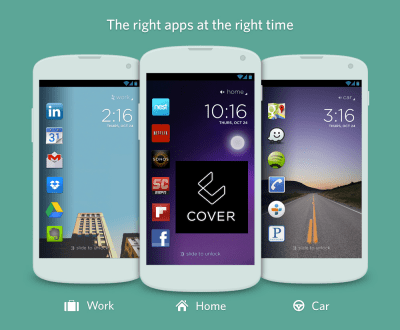
You have more apps than you know what to do with, but Cover could fix that. It’s an Android lockscreen replacement launching (invite-only) today that adapts to show your top productivity apps at work, favorite chill out apps at home, and driving apps in the car. With a $1.7 million seed led by First Round Capital, Cover is proudly Android-first and -only, and could expose the inflexibility of iOS.


“Now’s the time to be betting on Android” I’m excitedly told by lauded venture capitalist Josh Kopelman, who spearheaded First Round’s investment in Cover. The startup’s CEO Todd Jackson echoes Josh’s passion for the open operating system. “The Android ecosystem and market is huge, yet every other startup goes iOS first. There are all these users used to getting things second and that sucks. There’s a huge market opportunity. I really want Android users to say, ‘Finally, a company building for Android first.’”


Cover couldn’t work on any other OS. It leverages all the super powers of Android — replacing the lockscreen, knowing when you use your other apps, monitoring your sensors to determine what apps to bring up, and even modifying your ringer settings on the fly.


Below you can watch a quick demo of Cover and my interview with co-founder Jackson where he discusses iOS vs Android.


With Cover, Context Is King And Speed Is Queen


Once you sign up for a Cover invite and get one,  the startup puts you in its beta tier and you’ll see Cover in the Google Play Store. Once installed, it takes over your lockscreen, but leaves your homescreen launcher and all the customization you put into it intact. The only set up questions it asks are your work and home address.


Cover establishes a geo-fence around these locations and whenever you go there, the left side of your lockscreen shows a column of six of your apps that fit that situation. At first, these suggestions are crowdsourced, so you’ll see popular business apps like Google Drive, Dropbox, LinkedIn, and Asana at work, or Netflix, Kindle, and Facebook at home. With time, though, Cover learns your habits and personalizes itself to show your favorite apps for these occasions.


When you’re outside these geo-fences, you’ll see your on-the-go apps like Twitter and Facebook. Plug in your headphones and your music apps pop up. And If Cover detects accelerometer patterns that suggest you’re in a car, it brings up Waze and Google Maps. When Jackson demo’d Cover for me,  and manually brought up ‘driving mode’, Cover revealed Gmail for him. “Uh, oh” he said a little ashamed. “Red lights, dude.”


Cover’s “Peek” feature is the fastest way to open apps I’ve ever seen. Start pulling an app icon to the right and the lockscreen slides away to reveal the app’s innards as if it was open all along. This makes it remarkably quick to check notifications in a slew of apps.


Sequence 01.Still001Cover


Cover’s rapid app-switching lets you drag down from the top right corner of your phone at any time, even inside other apps, to reveal shortcuts to your most recently used apps and top ones based on your current context. It eliminates all those extra homescreen buttons so you can quickly jump back and forth between maps and messaging.


Finally, smart settings let you tell Cover you want your phone’s ringer muted at work and after midnight at home, but on full-blast if you’re out and about or home in the afternoon.


It was hard not to be impressed by Cover. The right apps at your fingertips which you can instantly preview and bounce between. And since I typically carry and iPhone, it made me a bit jealous. That’s a dangerous concept for Apple, whose business is built on being coveted.


iOS: Closed To Innovation


The iPhone used to be far and away the best smartphone. Android were clunkers. But over the last few years, Android manufacturers including Samsung and HTC have built some beautiful devices like the Galaxy S4 and HTC One with next-level features like gaze tracking. Jackson jokes “whereas the iPhone vs two years ago…it has a fingerprint scanner and comes in different colors.”


Cover PeekMeanwhile, the Android software is advancing by leaps and bounds. There are still magical flourishes in iOS 7 that give it unmatched polish, but without as big of a hardware or software advantage, Apple’s price points could get harder to swallow.


Its lack of flexibility isn’t doing Apple any favors. The last few years we’ve seen a wave of powerful Android-only apps emerge. There’s auto-categorized contextual homescreen Aviate, crowdsourced phone book and call-blocking app Mr Number, and even the maligned Facebook Home. (Aviate and Home are both Cover competitors, but wash away your carefully organized homescreen while Cover is a hide-able layer on top). They’re are all powerful, but either a bit complicated and niche, or change too much of your phone’s experience.


What they succeed at, though, is making iOS look rigid. Whether it’s Cover or another, if there’s a blockbuster hit Android-only app, it will expose the stubbornness of the closed iOS development platform, and combined with rapidly improving Android hardware and software, could make a bunch of people ditch their iPhone when it’s time to upgrade.


A Home For Wayward Android Engineers


Honestly, I wouldn’t be surprised if Cover was the messiah of Android. It provides a ton of value with minimal work, and you don’t have to sacrifice your existing customization. With one swipe, Cover disappears and reveals your old homescreen with all your folders and widgets.


Investors believe too. Along with Josh Kopelman andFirst Round Capital, Cover’s $1.7 million seed round comes from Harrison Metal Capital (Michael Dearing), Max Levchin, Scott Banister, Charlie Cheever, Keith Rabois, Dave Girouard, and Alex Franz — a mighty cap table.


Cover LogoKopelman tells me “We fund a fair number of companies but this one gets me really passionate and excited because I see the future here.” Charlie Cheever tells me “looking around on airplanes or public places, I’m seeing the percentage of android phones going up and up, but there’s not much focus from developer community on it. There’s a big opportunity to make [the Android software] much better.”


They’re betting on a team that really understands context. Jackson was a product manager at Google from 2004 to 2011, where he led feature development on Gmail for four years before working on News Feed and photos at Facebook for a year. Co-founder and CTO Edward Ho was a product director at Google+ from 2011 to 2012, and a Google software engineer for four years before that. Co-founder Gordon Luk brings design and user experience chops with him from his work as an indie game developer after selling the events company Upcoming.org he co-founded to Yahoo in 2005.


Together, they’re looking to hire Android developers who are sick of just porting iOS apps. “There are lots of talented Android engineers stuck at iOS-first companies.” While Cover is simple, it’s still a radical new way to use your phone. It’s challenge, and the easiest way it could fail, will be trying to fundamentally change our mobile behavior.


Cover, A Gateway To App Discovery


While Cover could be great for users, it may actually help other developers too. People are becoming weary of downloading too many apps because it’s a pain to organize them and tough to remember to use them. Cover could wash away that mental cost of downloading more apps, allowing other devs to find an audience.


It might even be able to make money on discovery. While Jackson was adamant that the first two phases for Cover are building a great product and growing its userbase, eventually when it monetizes, it could be by suggesting apps for the right occasion that you haven’t downloaded yet.


vertical_graphicImagine going to a tech conference where you didn’t know there was a schedule app. Cover could see everyone else in your vicinity is using it, and suggest you download it too. Loyalty app companies might pay to have their apps suggested when you’re at restaurants they work with. Or if you’ve been playing games for 20 minutes, Cover might recommend other apps by your favorite developers…if they pay.


One day, Cover could even take contextual computing beyond managing your apps, and use your surroundings and habits to deliver you pure information. Jackson dreams aloud, “Imagine if Cover v2 could prioritize push notifications. When I get Fab (shopping app) notifications at work I never open them but at home I do.” Cover could know to save those alerts until you get home. It could bump up the frequency of breaking news notifications when you’re using leisure app, but mute them in the car.


Jackson conclude, “There’s so much more on Android that we think it’s an invest-able area and now is the time.”


Source: http://feedproxy.google.com/~r/Techcrunch/~3/JMwMXU1N_uQ/
Similar Articles: suntrust   yosemite national park   mariano rivera   never forget   Ichiro Suzuki  

Cos. offer health benefits to transgender workers

Jamison Green, a transgender man, poses for photographs in San Francisco, Wednesday, Oct. 9, 2013. Jamison Green, a transgender man who owns Jamison Green & Associates, a transgender benefit consulting firm, says part of the reason more companies donĆ¢€™t offer transgender benefits is that many are not aware that the insurance theyĆ¢€™ve purchased excludes treatments for transgender employees. Green says much of his work involves walking employers through the process of removing those exclusions. (AP Photo/Jeff Chiu)


Jamison Green, a transgender man, poses for photographs in San Francisco, Wednesday, Oct. 9, 2013. Jamison Green, a transgender man who owns Jamison Green & Associates, a transgender benefit consulting firm, says part of the reason more companies donĆ¢€™t offer transgender benefits is that many are not aware that the insurance theyĆ¢€™ve purchased excludes treatments for transgender employees. Green says much of his work involves walking employers through the process of removing those exclusions. (AP Photo/Jeff Chiu)


Jamison Green, a transgender man, poses for photographs in San Francisco, Wednesday, Oct. 9, 2013. Jamison Green, a transgender man who owns Jamison Green & Associates, a transgender benefit consulting firm, says part of the reason more companies donĆ¢€™t offer transgender benefits is that many are not aware that the insurance theyĆ¢€™ve purchased excludes treatments for transgender employees. Green says much of his work involves walking employers through the process of removing those exclusions. (AP Photo/Jeff Chiu)


(AP) — When Koset Surakomol decided to have a sex change operation, the company she worked for told her co-workers that the man they'd labored alongside for a dozen years should be addressed as a woman going forward.

But EMC Corp.'s support didn't end there: The data storage company paid tens of thousands of dollars for her to undergo hormone therapy, breast augmentation and facial contouring. It also will foot the bill later this year when Surakomol has the operation that will complete her transformation — a benefit EMC began offering in 2007.

"I got no bad reactions, no cold shoulders," says Surakomol, an information technology engineer. "All I heard was, 'This is wonderful.'"

It's a story that would've been unheard of a decade ago. EMC, which has 60,000 employees, is one of a growing number of Fortune 500 companies expanding their health care benefits to meet the needs of workers who have gender dysphoria, the medical term for those who identify themselves as the opposite gender that they were assigned at birth.

Despite the gains in coverage for these transgender employees, many companies are unwilling to speak publicly about their benefits. But Delia Vetter, director of benefits at Hopkinton, Mass.-based EMC, says, "Everyone has a right to be naturally happy."

From Apple to General Mills, nearly one fourth of Fortune 500 companies cover medical expenses associated with transgender care, according to gay and transgender rights group Human Rights Campaign. That's up from 19 percent last year. When the group began tracking transgender benefits in 2002, no Fortune 500 companies offered them.

Corporate America's outreach to transgender workers points to the increasing visibility of a group once relegated to society's fringes. Recently, more than a dozen states revised anti-discrimination laws to include transgender people. Meanwhile, transgender officials have raised the group's profile by winning elected office and landing appointments in President Obama's administration.

The trend also shows how much companies want their workplaces to be perceived as welcoming and progressive. Since the Human Rights Campaign began grading companies on the inclusiveness of their benefits for gay, lesbian, bisexual and transgender employees, many companies have beefed up their benefits for those groups.

Beginning in 2011, companies could only maintain a coveted 100 percent rating on the group's Corporate Equality Index by offering at least one insurance plan covering up to $75,000 worth of counseling, hormone therapy and sexual reassignment surgery — the medical term for a sex change operation. The number of Fortune 500 companies meeting the requirement jumped to 121 this year from 39 in 2011.

"Companies are recognizing that ... in order to remain competitive in corporate America, you can't offer discriminatory plans" says Jennifer Levi, a professor at the Center for Gender and Sexuality Studies at Western New England University in Springfield, Mass.

While more companies offer transgender benefits, most government programs like Medicare and Medicaid classify sexual reassignment surgery as cosmetic or experimental and do not cover it.

But Obama's health care overhaul could expand benefits for transgender people. While the law doesn't require coverage of sexual reassignment surgery per se, it's expected to lower barriers for other forms of care. Starting in 2014, insurers, hospitals and doctors that receive federal dollars won't be allowed to deny coverage to patients with pre-existing conditions, including gender dysphoria. Since most U.S. insurers and hospitals receive federal payments, they will be subject to the requirement.

Transgender benefits are a new consideration in the U.S. For decades, the only way to transition to the opposite sex was to pay for the procedure out of pocket.

The first modern sexual reassignment operations were performed in Germany in the 1920s. The surgery, which can cost $20,000 to $50,000 or more, can involve breast implantation or removal, and genital reconstruction to reshape them to resemble those of the opposite sex.

It wasn't until the 1950s that most Americans first learned of the procedure. That's when Christine Jorgenson, born George Jorgensen, became the first transgender person to receive national media attention.

Still, only in the late 1970s did health care professionals develop the first medical guidelines for diagnosing and treating sexual identity disorder, which has since been renamed gender dysphoria. The group, called the World Professional Association for Transgender Health, recommends people receive at least one year of hormone therapy in advance of the surgery. Hormones help patients develop physical characteristics of the opposite sex. For example, high-dose estrogen injections spur breast development and increased fat around the hips.

Today, the majority of the estimated 500 to 750 Americans who undergo sexual reassignment each year still have to bear the cost themselves, with hundreds more traveling abroad to find lower-priced procedures. Many exhaust their life savings.

For most corporations, the cost of adding transgender care is negligible because few people will need it. The amount varies based on the company's size, insurance offerings and other factors. According to one estimate by Jamison Green & Associates, a transgender benefit consulting firm, a company with 200,000 employees would see two people undergo sexual reassignment surgery in roughly 5 years.

Still, most private health insurance offered by employers excludes coverage for transgender-related care. Jamison Green, a transgender man who owns the benefit consulting firm, says many companies aren't aware the insurance they've purchased excludes treatments for transgender employees. Green says he walks employers through the process of removing those exclusions.

"The company has to give a clear directive to their provider: 'We really do want a policy that has these exclusions removed,'" says Green, who lives outside San Francisco.

Advocates say even some companies that cover transgender care come up short. For instance, for men becoming women, having facial reconstruction and hair removal can be even more important than a sex change operation because it affects how they are perceived and treated. Yet many transgender-inclusive plans do not cover the procedures.

One transgender woman who works for a large California-based pharmaceutical company said her benefits covered $43,500 in breast implants and genital reconstructive surgery, including removal of the testes. But she says she still spent $60,000 on procedures not covered by her insurance, including electrolysis and facial contouring. She insisted on anonymity for herself and her company for fear that publicity could affect her employment.

Michaeline Burke, who lives in St. Cloud, Minn., had other issues as she tried to transition. Burke was born a man but has lived as a woman since 2009. As an adjunct professor of biology at several universities in the Midwest, she's consistently had health coverage, but still has faced hurdles.

For instance, Burke was receiving hormones and psychotherapy through her employer, a state-sponsored university in North Dakota. But after about a year of hormone therapy she received a letter from her insurer indicating that the plan excluded coverage for sexual transition costs.

"As soon as they figured out it was for gender reassignment they stopped coverage and basically made me pay back everything," Burke says.

Burke now works at the University of Minnesota, where she is covered for her hormone therapy and counseling. The university covers sexual reassignment surgery, but Burke won't have time to undergo the procedure before she leaves the university to start a new career as a social worker. Even while interviewing for new jobs, Burke doesn't ask potential employers about insurance coverage.

"I'm pretty reluctant to ask upfront 'Do you cover these things?'" says Burke, who plans to travel to Thailand and pay for sexual reassignment surgery out-of-pocket if her new employer doesn't cover the cost. "There are still a lot people out there who don't want trans people around."

Associated PressSource: http://hosted2.ap.org/APDEFAULT/bbd825583c8542898e6fa7d440b9febc/Article_2013-10-24-Transgender%20Health%20Benefits/id-6db04fa8f2ec40a7a3ddc3926cb161b5
Tags: Ozymandias   CDOT   vince young   Call Of Duty Ghosts   Desiree And Chris  

Netflix's 3Q earnings quadruple, stock soars

FILE - This Jan. 29, 2010, file photo, shows the company logo and view of Netflix headquarters in Los Gatos, Calif. Netflix reports quarterly earnings on Monday, Oct. 21, 2013. (AP Photo/Marcio Jose Sanchez, File)


FILE - This Jan. 29, 2010, file photo, shows the company logo and view of Netflix headquarters in Los Gatos, Calif. Netflix reports quarterly earnings on Monday, Oct. 21, 2013. (AP Photo/Marcio Jose Sanchez, File)


(AP) — Netflix's earnings quadrupled as the Internet video subscription service's line-up of original programming helped attract 1.3 million more U.S. subscribers during its latest quarter.

The July-September financial results announced Monday are the latest evidence of Netflix's increasing popularity as the service's video library expands to include exclusive, high-caliber shows. The strategy is getting rave reviews among investors whose adulation has quadrupled Netflix's market value so far this year.

Netflix's stock soared again Monday, rising $38.01, or nearly 11 percent, to $393 in extended trading after the numbers came out. That sets up the shares to hit an all-time high for the third consecutive trading session on Tuesday.

"They are growing nicely, and they deserve credit for that," said Wedbush Securities analyst Michael Pachter. "But I still don't understand how they can be valued this high."

In a Monday interview, Netflix CEO Reed Hastings acknowledged "there seems to be some euphoria" surrounding the company's stock.

Investors increasingly view Netflix as the leader in a technology upheaval that will redefine the entertainment landscape for decades to come. The Los Gatos, Calif., company is steadily winning new converts to an $8-per-month service that streams TV shows and movies to any device with an Internet connection. Some households are so enamored with Netflix that they are canceling more expensive subscriptions to cable- and satellite-TV services.

Netflix ended September with 31.1 million U.S. subscribers, eclipsing the estimated 29 million subscribers that HBO's 41-year-old pay-TV channel is believed to have in the country.

HBO, which is owned by Time Warner Inc., still has a commanding lead globally with 114 million subscribers around the world.

Netflix Inc., in contrast, has 40.3 million subscribers worldwide after adding 1.44 million customers outside the U.S. in the July-September quarter. The company's streaming service is available in 41 countries, and Netflix plans to enter another yet-to-be identified overseas market next year.

The third quarter covered a three-month stretch that featured the debut of two exclusive series. They were the critically acclaimed "Orange Is The New Black," and "Derek," which also got largely positive reviews. In a Monday letter reviewing the third quarter, Netflix predicted "Orange Is The New Black" — a drama/comedy set in a women's prison — will end this year as its most-watched piece of original programming yet, outstripping "House of Cards," a hit released earlier this year that won three Emmy awards.

Hastings told The Associated Press that "Orange Is The New Black" played such a big role in the company's success during the third quarter that he considered staging a special tribute to the series during a Monday discussion of the earnings that was shown on a video feed. "I almost did the earnings show in an orange jumpsuit," Hastings quipped, adding he was overruled by Netflix's head of communications.

Netflix earned $32 million, or 52 cents per share, in the quarter. That compared with income of $7.7 million, or 13 cents per share, at the same time last year.

Analysts surveyed by FactSet had forecast earnings of 48 cents per share.

Revenue rose 22 percent from last year to $1.1 billion to match analyst projections.

Netflix expects to add another 2.5 million to 4.1 million subscribers worldwide in the current quarter ending in December, including an additional 1.6 million to 2.4 million in the U.S.

The lofty gains in the company's stock price are starting to unnerve Hastings, who recalls the shares increasing by nearly five-fold in 2003, only to plunge by 77 percent the following year as investors fretted about stiffening competition and higher expenses for a DVD-by-mail rental service that was once Netflix's financial backbone. Hastings also watched the stock plummet by more than 80 percent from its highs reached in 2011 after Netflix imposed pricing changes that triggered a customer backlash.

Associated PressSource: http://hosted2.ap.org/APDEFAULT/495d344a0d10421e9baa8ee77029cfbd/Article_2013-10-21-Earns-Netflix/id-f5bab6570d8f45478f97378e1663e816
Related Topics: First Day Of Fall 2013   Million Second Quiz   K Michelle   Reza Aslan   JJ Cale  

Galaxy Gear compatibility comes to the Samsung Galaxy S4, S3, Note 2 and more

If you wanted live out your Inspector Gadget fantasies, but lacked the Galaxy Note 3 needed to take full advantage of the possibilities, we've got good news. Samsung's bringing compatibility for its Galaxy Gear to the previously-mentioned Galaxy S4 as well as the Galaxy S III and Galaxy Note II ...


Source: http://feeds.engadget.com/~r/weblogsinc/engadget/~3/RCzubZ6f1LI/
Category: Lara Flynn Boyle   demarco murray   walking dead   iOS 7   amc